From workshop validation to mine testing: Lessons learned from the electrified and autonomously navigating Gradall
By Jesse Sainio, Tapojärvi
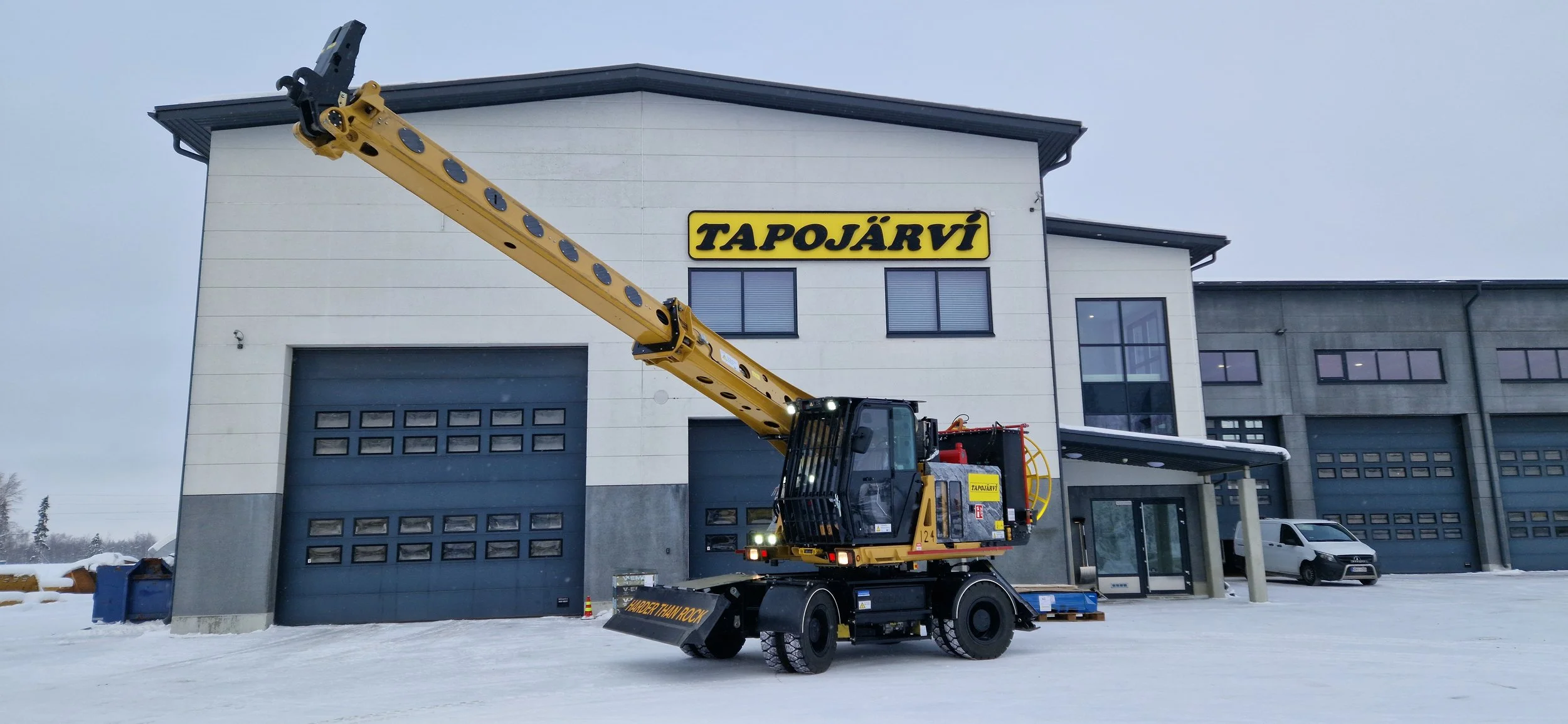
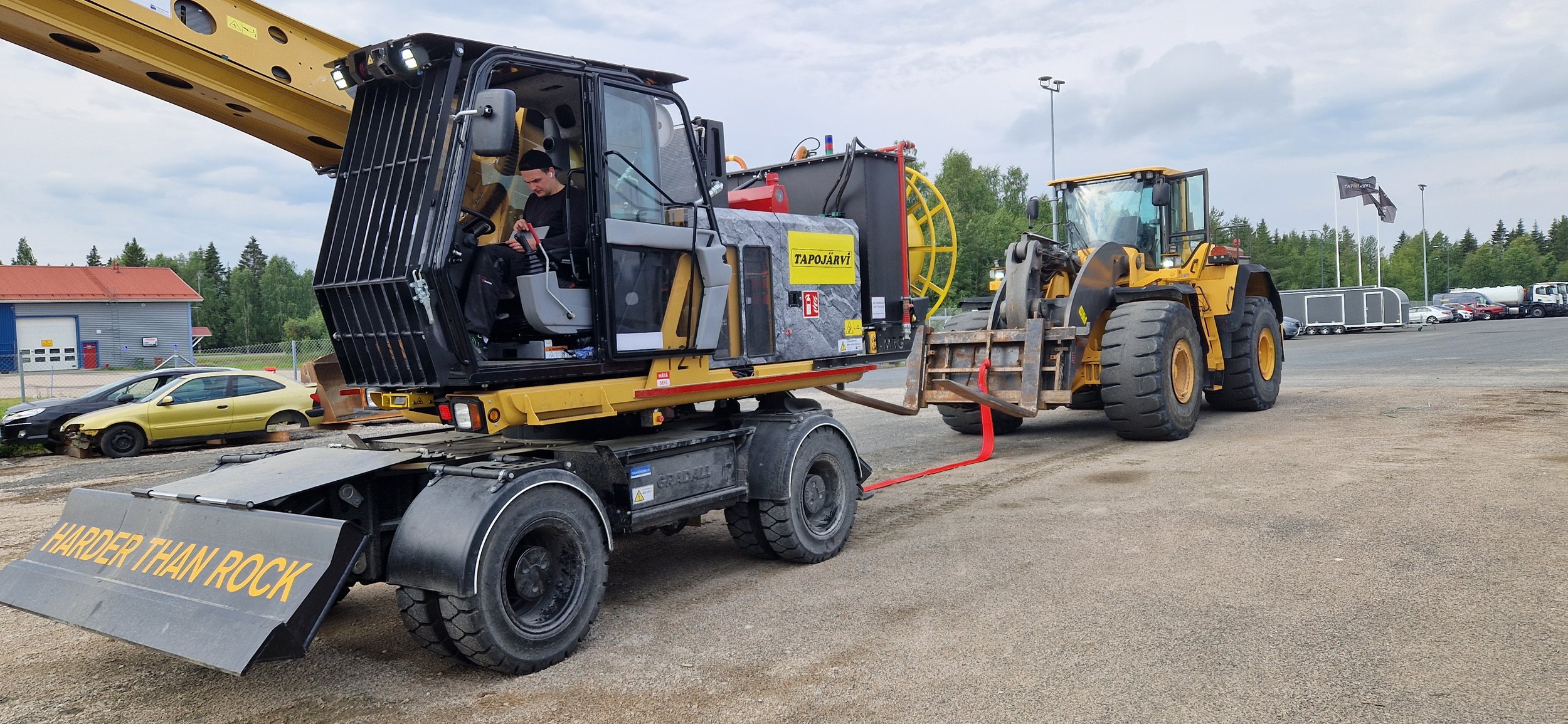
The development and testing of an electrified and autonomously navigating Gradall scaling machine has provided valuable practical insight into the challenges associated with introducing new technologies into demanding underground environments. The project has progressed through several stages, from initial inspections and workshop testing to preparations for underground mine trials.
While the project has not progressed entirely according to the original schedule, the technical issues encountered along the way have generated important knowledge. In many respects, these unexpected situations have provided some of the most valuable results of the project by highlighting the importance of systematic testing, comprehensive system validation and sufficient flexibility in the development process.
From machine delivery to technical assessment
The electrified Gradall arrived at Tapojärvi’s central workshop in February. The first technical issue was encountered immediately: a fault related to the machine computer’s memory prevented normal operation, and the machine had to be towed off the transport trailer.
Once the computer issue had been resolved, a more detailed assessment of the machine and its retrofit systems could begin.
The assessment involved Tapojärvi specialists from several technical disciplines. Particular attention was paid to machinery safety requirements, relevant standards and the general principles of safe machine design. Several deficiencies and areas requiring further development were identified during this phase and corrected before testing continued.
This initial assessment highlighted an important principle in retrofit projects: major modifications to an existing machine should always be considered at system level.
Replacing or modifying systems related to propulsion, control or safety can have consequences far beyond the individual components involved. Mechanical systems, electrical systems, hydraulics, software, control functions and safety solutions are interconnected, and changes in one area may introduce new requirements or loads elsewhere in the machine.
Gradually increasing the test load
Following the initial inspections and corrective actions, practical testing was started at the central workshop. The aim was to increase the machine’s operating load gradually and assess the performance and durability of the electrified machine before moving to a more demanding underground environment.
The Gradall was tested through normal driving as well as by loading the working hydraulics. During this phase, a mechanical failure occurred in the drive transmission when its bearings failed. Larger bearings were subsequently machined and installed, allowing the test programme to continue.
The failure provided an important reminder that electrification does not affect only the electrical system. Changes in motor characteristics, torque delivery and operating loads can also influence the mechanical drivetrain. The original machine configuration may experience different loading conditions after electrification.
Additional towing tests were therefore carried out together with another work machine. The Gradall was tested both while towing another machine and while being towed itself. These tests were intended to reproduce higher-load situations comparable to those expected in inclined mine tunnels.
Conducting such tests at the workshop proved particularly valuable. Loads could be increased in a controlled manner while the behaviour of the machine was continuously monitored. At the same time, technical problems could be investigated and corrected more efficiently than would have been possible underground.
Promising progress in autonomous navigation
In parallel with testing the electrified drivetrain, the autonomous navigation system was also evaluated.
The system uses environmental perception technologies including LiDAR sensors. Importantly, the workshop testing was performed with the same key sensing and navigation components intended for underground operation.
Autonomous driving tests were carried out in the central workshop area, and the results at this stage were promising. The machine was able to navigate autonomously within the test area without major issues.
These results supported the decision to proceed towards the next phase of the project: testing both the electrified machine and the autonomous navigation system in an actual mine environment.
Pyhäsalmi Mine was selected as the planned test location. Callio, operating at the site, provides access to various underground and open-pit test environments and routes suitable for technology demonstrations.
Moving from an open workshop area into a mine environment represents a significant step in the validation process. Tunnel geometry, gradients, lighting conditions, surrounding structures and other mine-specific characteristics place considerably more realistic demands on perception, navigation and the machine as a complete system.
A last-minute technical issue changed the plan
Just as preparations for underground testing were approaching completion, an insulation resistance fault was detected in the machine. Because the Gradall is a high-voltage electric machine, any abnormality in insulation resistance must be investigated before operation can safely continue.
During troubleshooting, the focus shifted towards the high-voltage battery system. Further measurements revealed abnormalities in the battery pack, including two cells with clearly lower voltages than expected. The finding had an immediate impact on the test plan.
The machine could not be transferred to mine site testing before the condition and safety of the battery system had been properly investigated. It was therefore transported back to Tampere University for further diagnostics and corrective work.
This situation illustrates one of the realities of technology demonstration projects. Individual subsystems may perform successfully while another part of the machine prevents the overall system from progressing to the next validation stage.
In this case, the autonomous navigation system had shown promising results, but the reliability and safety of the high-voltage system ultimately determined whether mine testing could proceed.
The importance of staged validation
One of the clearest lessons from the project has been the value of staged testing. New technology should not be transferred directly into its most demanding operating environment. Instead, testing should progress from individual components and functions towards system-level testing and, finally, validation under real operating conditions.
The workshop phase made it possible to identify several technical issues in an environment where corrective actions could still be performed relatively efficiently.
The transmission bearing failure is a good example. Had the same failure occurred after the machine had already been transferred underground, the consequences in terms of logistics, safety, schedule and available resources could have been significantly greater.
The same principle applies to the insulation resistance fault and battery issues. Although they delayed the transition to mine testing, detecting them before underground deployment prevented a potentially more difficult situation later in the test programme.
Unexpected problems are also project results
Development projects often focus on demonstrating what works. However, identifying what does not yet work can be equally valuable.
A fault discovered during testing should therefore not automatically be considered a failure of the test programme. Finding technical weaknesses before deployment is one of the main purposes of validation.
In this project, technical challenges have appeared in several areas, including the machine computer, mechanical drivetrain and high-voltage battery system. These findings demonstrate why prototype and demonstration projects require sufficient time for troubleshooting, corrective actions and repeated validation.
They also show why detailed documentation is essential. Test results, faults, technical modifications and subsequent retesting together form an important knowledge base for future machine development.
In many cases, unexpected deviations provide more practical information than a test in which everything operates exactly as expected.
Key lessons for future retrofit and demonstration projects
Several practical lessons can already be identified from the work carried out so far:
· Evaluate retrofit solutions as a complete system. Mechanical, electrical, hydraulic, control, software and safety systems are interdependent and should not be assessed only in isolation.
· Use a staged testing process. Testing should progress from individual functions to integrated system testing and finally to the actual operating environment.
· Apply realistic loads before deployment. Mechanical and electrical systems should be tested under representative load conditions before the machine is transferred to a more demanding environment.
· Monitor critical components throughout the test programme. Changes in the condition of key systems may develop during testing and should be identified as early as possible.
· Include sufficient flexibility in the project schedule. Prototype and demonstration machines often require troubleshooting, redesign and repeated testing.
· Document deviations as carefully as successful tests. Faults, corrective actions and retesting provide valuable information for future development and risk reduction.
The next step: mine environment validation
The immediate priority is to resolve the issues associated with the high-voltage system and battery pack so that safe testing can continue.
The objective is to return the machine to test-ready condition within the remaining project period and to carry out the planned underground mine tests before the end of November.
Although the technical challenges encountered during the project have delayed the original schedule, they have also produced valuable information on the development of retrofit solutions for electrified and autonomously navigating heavy machinery.
One of the central conclusions from the project so far is that a successful technology demonstration is about much more than showing that a new function works. The complete machine must also be safe, reliable and suitable for its intended operating environment.
From this perspective, the difficulties encountered during the development process are not separate from the project results. They are an essential part of them.
They provide concrete evidence of the technical questions that must be addressed before electrified and autonomously navigating heavy machinery can be introduced more widely into demanding underground operations.